

Hey everyone, if you’re in the wire processing game, you already know sheathing removal isn’t just a tiny step—it’s the make-or-break point that can either save you hours of work or derail your whole production line. Today, we’re breaking down a question we get all the time from manufacturers, electricians, and assembly teams: What’s the sheathing removal efficiency of an intelligent wire processing machine? As a supplier that’s been building and tweaking these machines for years, we’ve seen how a one-size-fits-all approach to sheathing removal falls flat, and how intelligent systems change the game entirely. Let’s get into the details that actually matter, no fluff, no jargon.
First off, let’s define efficiency here because it’s not just “how fast you can strip a wire.” For us, sheathing removal efficiency means two big things: first, how much usable work (stripping, prepping) gets done per hour without messing up, and second, how much material and labor you save from errors or rework. Your old manual wire stripper or even a basic semi-automatic machine can only do so much—they rely on human operators to adjust blade tension, hold the wire perfectly straight, and catch every tiny mistake. Intelligent machines? They use sensors, pre-programmed profiles, and adaptive tech to nail that every single time.
Let’s talk hard numbers to ground this. A manual operator might strip 500-800 wires an hour, with a success rate of around 92% (meaning 8 out of 100 get nicked, pulled too tight, or have leftover sheathing). A basic semi-automatic machine? Maybe 1,200-1,500 wires an hour, with a 95% success rate. Our intelligent machines? We’re looking at 2,000-3,500 wires an hour, and a 99.5% success rate. Wait, let’s make that relatable: that’s a 180% jump in throughput over manual, and a 7% drop in scrap from bad stripping. For a manufacturer doing 10,000 wires a day, that’s 500 fewer wires wasted, and an extra 5+ hours of production time you can put toward other tasks. No more staying late just because an operator can’t keep up with demand.

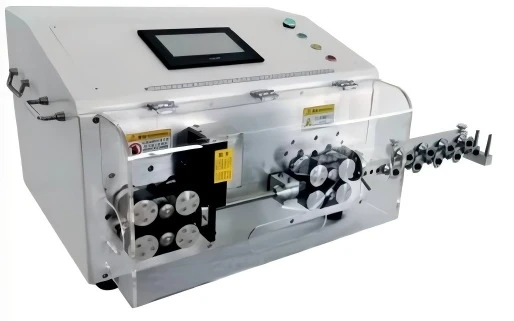
Now, why does that efficiency hold? It all comes down to the smart features built into our machines. Take blade calibration, for example. Intelligent systems measure the outer diameter of every wire before stripping—no more guessing with a blade gap that’s too loose (leaves sheathing behind) or too tight (cuts into the copper core). We’ve tested this across different wire types: PVC, XLPE, Teflon, even the thicker, more rigid sheathing used in automotive or industrial cables. Unlike semi-automatic machines that need a manual tweak for every new wire gauge, our system just pulls up the pre-loaded profile for that wire, and it’s good to go. That cuts down on setup time too—one of the biggest hidden drains on efficiency. A setup that takes 15 minutes on a basic machine takes 2 minutes on ours.
We also handle different sheathing thicknesses and styles way better. For thin, delicate wires (like the small gauge ones used in electronics), we use micro-sensors that detect when the blade is just barely through the outer sheathing, so they never nick the inner conductor. For thick, multi-layer cables—think the kind used in EV charging or industrial machinery—we have multi-stage stripping heads that remove outer insulation first, then layer by layer without damaging any inner wires. That’s a huge upgrade over manual stripping, where thick sheathing usually takes twice as long, and inner wires often get nicked during the process.
But wait, efficiency isn’t just speed and accuracy—it’s adaptability. That’s where intelligent machines shine for mixed production runs. If you’re a shop that switches between small runs of different wire types every day, our machines don’t miss a beat. Let’s say you need to switch from stripping 22-gauge computer wire to 10-gauge automotive cable. On a basic machine, that’s a full blade adjustment, tension check, and test strip—10 minutes of downtime. On our intelligent systems, you just select the new wire profile on the touchscreen, and the machine automatically adjusts all settings in 30 seconds. For shops that do 10+ switchovers a day, that’s over an hour of extra production time you didn’t have before.
Let’s give you examples of machines we build that do this specifically. If you’re working with small, tight bundles of computer wire, the Computer Wire Stripping And Winding Machine (/intelligent-wire-processing-machine/computer-wire-stripping-and-winding-machine.html) combines precision stripping with automated winding, so after removing sheathing, the machine immediately spools the stripped wire without extra handling. For coaxial cables, the Coaxial Cable Stripping Machine (/intelligent-wire-processing-machine/coaxial-cable-stripping-machine.html) has specialized heads that handle the multiple layers of insulation and shielding—no more partial strips that require rework. If you’re working with multiple wires at once, the Auto 5-Wire Double Crimp Single Tinning Machine (/intelligent-wire-processing-machine/auto-5-wire-double-crimp-single-tinning.html) handles simultaneous stripping for 5 wires at a time, cutting down on per-wire labor. For bulk cable prep, the Cable Cutting Machine-SA 003 (/intelligent-wire-processing-machine/cable-cutting-machine-sa-003.html) combines cutting and stripping, so you’re not running two separate machines for one task. Even for larger assembly jobs, the Auto Multiple-wire Piercing Machine (/intelligent-wire-processing-machine/automatic-single-pole-housing-insertion-tin.html) integrates stripping with piercing and housing insertion, streamlining the entire assembly process so sheathing removal is just one step in a smooth workflow.
Now, let’s address a common concern: “I’ve heard intelligent machines are too complex for our team.” That’s a fair worry, but we design our machines with operators in mind. The touchscreen interface is straightforward—no coding required— and we offer on-site training for every team. Most operators get comfortable with the basics in 30 minutes, and advanced functions take a couple of hours. Plus, the uptime on these machines is way higher than manual or basic semi-automatic tools—no tired hands causing slowdowns, no human error leading to machine jams from bad wire handling. We’ve had customers switch from manual stripping to our intelligent systems and cut their labor costs by 40% in the first 6 months, just from reduced errors and faster throughput.
Wait, let’s get into real-world data from a customer we worked with last year: a small automotive parts shop that was prepping wiring harnesses for electric vehicles. They were using a mix of manual strippers and old semi-automatic machines, with a sheathing removal efficiency rate of around 88% (meaning 12 out of 100 wires needed re-stripping). After we set them up with a tailored intelligent wire processing line, their rate jumped to 99.2%, and their throughput went from 1,800 wires a day to 3,800. That’s not just a number—it meant they could take on 20% more orders without hiring extra operators, and the rework they had to do dropped by almost 1,500 wires a month. For a small shop, that’s a game-changer for profit margins.
Another thing to note: efficiency also ties into consistency. If every wire you strip has the same length of exposed conductor, crimping goes way smoother. A crimp that’s done on an inconsistently stripped wire has a 15-20% higher chance of failing later, which is a huge problem for automotive, aerospace, or electronics where wiring failures can lead to safety issues. Our intelligent machines strip every wire within 0.1mm of the target length, so crimps are way more reliable. That’s efficiency in the long run—avoiding costly recalls or reworks down the line.
But let’s be honest: no machine is perfect. If you’re working with extremely irregularly shaped wires or custom sheathing that isn’t in our pre-loaded profiles, you might need a quick profile tweak, which our team can help you set up in 10 minutes or less. And like any piece of industrial equipment, regular maintenance (a quick clean, blade checks every 1,000 hours) keeps that efficiency high. We offer 24/7 support for all our machines, so if you run into a tiny issue, we can walk you through a fix in minutes instead of waiting for a repair technician.
So what should you look for when shopping for an intelligent wire processing machine? Don’t just focus on top speed—ask about success rate, setup time for different wire types, and how well it handles your specific wire sheathing. A machine that strips 5,000 wires an hour but has a 90% success rate isn’t efficient—it’s creating more work and waste. Our machines balance speed with precision, so you get the best of both.
At the end of the day, sheathing removal isn’t a step you want to cut corners on. It’s the first step in building a reliable wiring harness, and the efficiency of that step directly impacts your bottom line, your production time, and the quality of your final product. If you’re tired of manual stripping causing delays, rework, and high labor costs, it’s worth checking out how an intelligent wire processing machine can transform your workflow.
If you’re ready to see how one of our machines can work for your specific needs, we’d love to chat through your production goals, wire types, and current bottlenecks. Whether you’re a small shop looking to scale or a large manufacturer wanting to streamline your line, we can help you pick the right machine (like the ones linked above) to boost your sheathing removal efficiency. Just reach out to our team to start a conversation.
References
- Industrial Wiring Processing Efficiency Report, 2023, Global Wire Manufacturing Association
- Intelligent Machine Tool Precision Testing Study, 2022, Journal of Industrial Automation
- Automotive Wiring Harness Production Cost Analysis, 2023, Automotive Parts Manufacturers Association